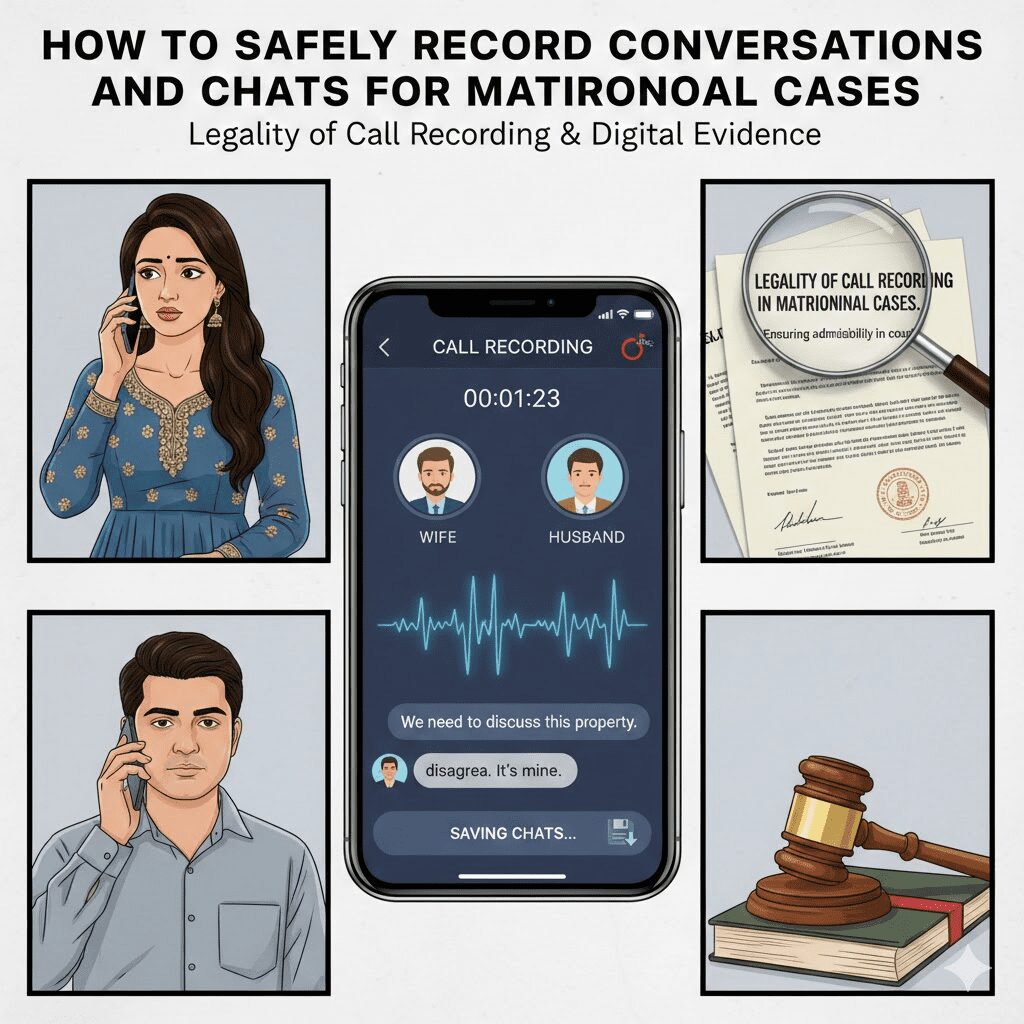
Matrimonial disputes me call recording aur chat evidence ek powerful lekin legally sensitive tool hai. Privacy, Telegraph Act, IT Act aur Evidence Act ke beech ek fine balance maintain karna padta hai. Neeche poora framework diya ja raha hai jo courts ke established principles, Supreme Court judgments aur High Court rulings par based hai.
1. Kya apni conversation record karna legal hai? (One-Party Consent Rule)
Agar aap khud conversation ka participant hain to apni hi call ko record karna legal hai. Yeh interception nahi hota.
Legal Basis:
- PUCL vs Union of India (1997) – Interception sirf State par restriction, private participant par nahi.
- Zulfikar Ali vs State (Delhi HC, 2020) – Apni conversation record karna privacy breach nahi.
Conclusion:
✔ Participant-party recording legal
✘ Doosre ki conversation secretly record karna illegal
2. Jab conversation aapke apne device par ho, tab legal position
Agar koi person aapke phone par call karta hai, ya aapke phone ka istemal karke dusre ko call karta hai, to recording device-owner ke perspective se legal hoti hai, kyunki yeh interception nahi balki self-documentation hota hai.
Applicable Principle:
- Device-owner ke paas apne device ki activities ko record karne ka lawful right hota hai jab tak wo third-party interception nahi karta.
3. Wife ne boyfriend ke sath husband ke phone par call ki aur recording auto-save ho gayi — kya yeh legal hai?
Phone husband ka tha, call husband ke device par hui, recording automatic thi, husband ne koi illegal tapping ya targeted surveillance nahi kiya. Yeh privacy violation nahi banega.
Legal Effect:
✔ No Telegraph Act violation (no unauthorized interception)
✔ No privacy breach (voluntary use of husband’s device)
✔ Evidence valid & admissible (R.M. Malkani principle)
4. Wife apne hi phone par boyfriend ke sath sexual/romantic talks kare, aur husband password hone par us phone me jaakar chats/recordings copy kare — kya legal hai?
A. Privacy Position
Personal device par highest expectation of privacy hoti hai. Password share hona unlimited surveillance ki consent nahi hoti.
Case Law:
- K.S. Puttaswamy (2017) – Personal device = high privacy zone
- Rayala Bhuvaneswari vs Nagaphanender (2007) – Password access ≠ permission to inspect private conversations
Conclusion:
✘ Husband ka secretly wife ke personal phone me jaakar private chats copy karna privacy breach hai
✘ IT Act Section 43, 66 ka risk hota hai
B. Admissibility Position
Matrimonial law me relevance aur justice ke interest ko privacy violation se upar rakha ja sakta hai. Illegal source hone par bhi evidence admissible ho sakta hai, agar wo:
- relevant ho,
- tampered na ho,
- matrimonial issue par direct impact rakhta ho.
Important Principle:
“Illegally obtained but relevant evidence may still be considered” – R.M. Malkani (SC)
Conclusion:
✔ Evidence admissible ho sakta hai
✔ Weightage kam ho sakta hai, par court ignore nahi karegi
✔ Cruelty, infidelity pattern, mental harassment, custody and maintenance issues par strong impact
5. Telegraph Act kab apply hota hai?
Telegraph Act sirf interception of live calls ke cases me apply hota hai. Chats, stored messages, device-access, ya password-based browsing par yeh act apply nahi hota.
Therefore:
✔ Stored chats ≠ Telegraph Act offence
✔ Unauthorized access = IT Act issue (privacy breach), not interception
6. IT Act implications
Kisi ke personal device me bina fresh consent ke ghuskar private data dekhna/copy karna IT Act ke Section 43 & 66 ke ambit me aa sakta hai. Password share hone se automatic blanket consent nahi milta.
7. Courts ka actual practical approach
Courts ne consistently yeh stance liya hai:
- Agar evidence relevant hai → Court consider karegi.
- Agar privacy breach hua hai → Court moral criticism karegi, par evidence ko outright reject nahi karti.
- Agar evidence se cruelty, conspiracy, infidelity ya safety threat establish hota hai → Court uski probative value dekhkar rely kar sakti hai.
8. Practical Rules for Safely Recording Evidence
✔ Sirf apni conversation record karein
✔ Apne device par hone wali calls ki recording legal hai
✔ Third-party calls tap na karein
✔ Original file ko untouched rakhein
✔ 65B certificate prepare karein
✔ Private devices (wife’s phone) me bina express permission ke access na karein
✔ Illegal method ki wajah se evidence ki weightage kam ho sakti hai
9. Summary of Both Critical Scenarios
Scenario 1 — Wife uses husband’s phone to talk with boyfriend; recording auto-save
✔ Legal
✔ No privacy breach
✔ Strong admissible evidence
Scenario 2 — Wife’s own phone, private sexual chats; husband accesses using shared password
✘ Privacy breach
✘ IT Act violation possible
✔ Evidence still admissible (relevance principle)
✔ Weightage reduced but not rejected
Yeh complete legal framework Indian Evidence Act, IT Act, Telegraph Act, Supreme Court privacy jurisprudence aur High Courts ke judgments par based hai, jise matrimonial disputes me secure aur defensible evidence-handling ke liye follow kiya ja sakta hai.