Introduction
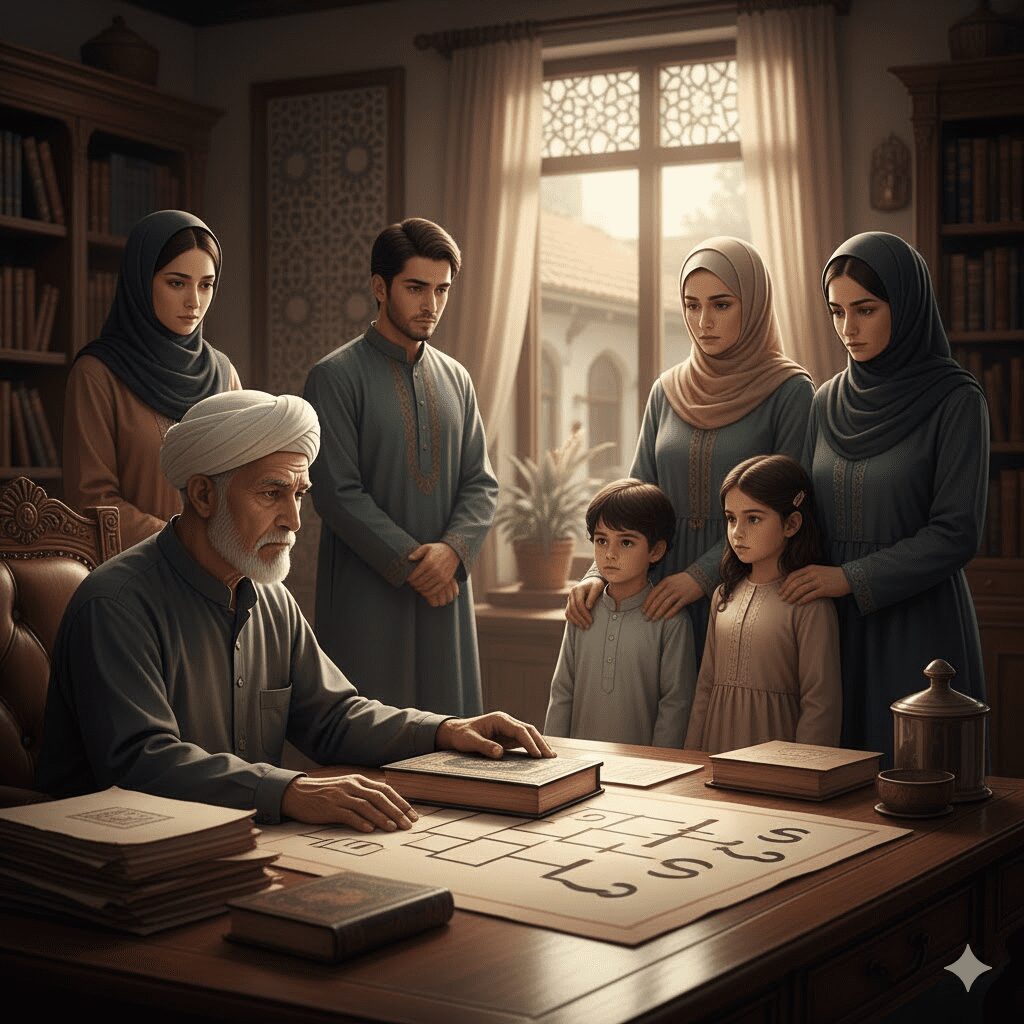
Inheritance in Islam is not merely a transfer of wealth; it is an act of obedience to Allah’s command. The distribution of property after death—known in Arabic as ‘Ilm al-Farāʾiḍ’—is a divine system established in the Qur’an and Sunnah. It ensures justice, balance, and protection for all family members.
Unlike man-made laws that often change with social trends, the law of inheritance in Islam is derived directly from revelation. Allah Himself fixed the shares of heirs, leaving no room for personal preference or discrimination. As stated in the Qur’an (Surah An-Nisa 4:11):
“Allah commands you concerning your children: for the male, what is equal to the share of two females…”
This divine command represents both equity and responsibility, not superiority or inferiority. The share depends on one’s role and obligation within the family system ordained by Allah.
The Qur’anic Foundation
The complete structure of inheritance was revealed in Surah An-Nisa (Chapter 4) — particularly in verses 4:7–12 and 4:176. These verses specify in precise language the shares of parents, spouses, children, and siblings.
- Verse 4:7: Declares equal entitlement for men and women: “For men there is a share of what the parents and close relatives leave, and for women there is a share of what the parents and close relatives leave—be it little or much.”
- Verses 4:11–12: Define shares for children, parents, and spouses.
- Verse 4:176: Clarifies rules for siblings when a person dies childless.
The Prophet Muhammad ﷺ said:
“Learn the laws of inheritance and teach them to others, for they are half of knowledge.” (Ibn Majah, Hadith 2719)
Thus, inheritance law (‘Ilm al-Farāʾiḍ’) holds an elevated position in Islamic jurisprudence.
Categories of Heirs in Islamic Law
Under Islamic law, heirs are divided into three main classes:
- Sharers (Ashab al-Furudh):
Those whose fixed shares are specifically mentioned in the Qur’an, such as parents, spouse, children, and grandparents. - Residuaries (Asabah):
Those who inherit the remainder after fixed shares are distributed — usually male relatives such as sons, brothers, or paternal uncles. - Distant Kindred (Dhawul Arham):
Relatives who inherit only if no sharer or residuary exists, such as maternal uncles, nieces, or distant cousins.
Each class inherits according to specific rules ensuring no rightful heir is deprived.
Examples of Distribution
To illustrate the fairness of this system:
- If a man dies leaving a wife and two children (a son and a daughter):
- The wife gets 1/8 (as per Qur’an 4:12).
- The remainder (7/8) is divided among the children — son gets twice the share of the daughter.
- If a woman dies leaving a husband and mother:
- The husband receives 1/2.
- The mother receives 1/3.
- The remaining 1/6 may go to other heirs, if any.
This precision removes conflict, speculation, and favoritism.
Principles Guiding the Division
- Inheritance follows death: It begins only after the person’s death and after paying debts and funeral expenses.
- Fixed shares cannot be altered: No will or gift can override Qur’anic shares.
- Debts and bequests come first: A maximum of one-third of the property may be bequeathed to non-heirs.
- No discrimination by wealth: Even poor relatives are entitled to their rightful share.
- Faith condition: Only Muslim heirs inherit from a Muslim, as per Islamic jurisprudence.
Origin and Development of Islamic Inheritance Law
The system originates directly from divine revelation (wahy). Before Islam, women and children were often excluded from inheritance. The Qur’an revolutionized this practice by giving women, widows, and minors legal rights to inherit.
Over centuries, jurists of different schools — Hanafi, Shafi’i, Maliki, and Hanbali — refined its application.
In India, the Hanafi school is the most widely followed. It forms the basis of the Muslim Personal Law (Shariat) Application Act, 1937, which directs Indian courts to apply Islamic principles in cases involving Muslims.
Modern Application in Indian Muslim Law
In India, inheritance among Muslims is governed by Muslim Personal Law, not by secular laws like the Hindu Succession Act.
Courts follow the Shariat Act, 1937, which mandates that all matters relating to succession, marriage, divorce, and inheritance among Muslims shall be decided according to Muslim Law (Shariat).
Key judicial principles:
- No concept of intestate succession by statute: Unlike Hindus, where a codified act governs succession, Muslims rely on uncodified fiqh principles.
- Courts accept Qur’anic shares as binding: Judges often consult standard fiqh texts (like Mulla’s Principles of Mahomedan Law) for clarity.
- Custom cannot override Shariat: Even if family customs differ, the Qur’anic rule prevails (as affirmed in several High Court judgments).
- Daughters’ rights are protected: Modern Indian courts have repeatedly upheld women’s right to inherit under Islamic law.
Common Misunderstandings
- “Sons always get more because of gender.”
❌ Incorrect. The son’s larger share is due to his financial responsibility — not gender. A male heir must provide for dependents; a female’s share is entirely her own. - “The father can distribute property equally during his lifetime.”
⚖️ A father can give gifts (hiba) during his lifetime, but doing so unequally among children without valid reason is discouraged in Islam (Hadith – Bukhari, 2586). - “Daughters lose inheritance after marriage.”
❌ False. A married daughter retains full inheritance rights from her parents’ property. - “Court distribution is different from Shariat.”
✅ The court applies the same Shariat principles; only procedural aspects differ.
Judicial Interpretation in India
Indian courts respect the sanctity of Islamic inheritance law.
Landmark judgments, such as Mohd. Ismail v. Sabir Ali (AIR 1963 All 581), reaffirm that Shariat supersedes custom.
In Bibi Aisha v. Ahmad Ali (AIR 1952 Pat 174), the court clarified that distribution must strictly follow Qur’anic shares, even if local practice differs.
Thus, the judiciary protects both religious authenticity and constitutional equality.
Frequently Asked Questions (FAQs)
Q1. Can a Muslim make a will (wasiyyah) for all his property?
No. A Muslim can only will up to one-third of his property for non-heirs. The remaining two-thirds must go to legal heirs according to the Qur’an.
Q2. What happens if there are no male heirs?
Female heirs (like daughters, mother, or wife) inherit fixed shares. If no direct heir remains, property may pass to distant kindred.
Q3. Does the Indian court require a religious certificate for distribution?
No. The court determines heirs based on documentary evidence (death certificate, legal heir certificate) and applies Shariat rules.
Q4. Can adopted children inherit under Muslim law?
Not automatically. They can receive gifts or bequests (within one-third limit) but are not Qur’anic heirs unless biologically related.
Q5. How are disputes among heirs resolved?
Through mutual settlement or court proceedings where shares are calculated as per ‘Ilm al-Farāʾiḍ’ and verified by documents.
Conclusion
The Islamic law of inheritance is a divine framework of justice — balancing rights and responsibilities, compassion and fairness.
Its purpose is not only to divide property but to maintain family harmony, protect the weak, and fulfill the command of Allah.
In India, this sacred system continues under the protection of Muslim Personal Law, ensuring that believers may practice their faith within a lawful constitutional framework.
Author’s Note
Written by Advocate Javed Ahmad (Member, Shahdara Bar Association since 2008), practising lawyer at Karkardooma Court, Delhi — with the intention of spreading awareness of the true Islamic method of inheritance and its lawful observance in India. This content is shared purely for educational and community purposes, not for income or promotion.
📍 Office: D-522(B), Karkardooma Court, Shahdara, Delhi – 110032
📞 Mobile: 9289925377
🕌 Purpose: “For the sake of knowledge, not commerce.”